Tuesday, May 27, 2014

Costa’s Hummingbirds return to feeders in Las Vegas NV – drought and heat make it better in town


I heard that familiar high-pitched whistle. It was May 20, 2014. I was standing in my kitchen. Since the weather was still mild the window was open. I heard a faint whistle. I stopped and listened. It was repeated. I could tell it wasn’t close.
Then in the evening of May 23, 2014 I was sitting outside enjoying the peaceful quiet and watching the feeders. I have installed yet a fourth feeder. This one is on the south side of my house, close to the block wall covered with Cat’s Claw Vine. I had my camera ready.
Hummingbirds are constantly at my feeders now. Friends report that hummers with nests near their homes have already fledged out this year’s first clutch and started on the second. I am now seeing females, males and immatures at my feeders. I knew I would need my camera.
As I sat there I heard a hummer coming to the south side feeder. I aimed my camera and got an image of it. When I looked at the results I could see it was a male Costa’s hummingbird. So I was right about hearing his whistle earlier.
Costa's male hovering next to my new feeder.
Then a female, or immature, I don’t know which, came to the feeder on the west side and I was able to snap a picture of her as well. I can see a little color on the throat, but I can’t be sure as to its ID.
This morning, as I was coming home from walking my dogs at 6 a.m., I heard the Costa’s whistle. This time it was loud and clear and only a short distance away. He repeated it again and again. I wonder if he’s planning to take over the place again.
I have not seen as many species this year as I did last spring. Again, I can only wonder. Is it because I had my feeders up all winter?  I may have a group of resident hummers that have made my house part of their feeding territory, not leaving room for the migrants. Or is it just because I am not seeing all the birds that come to the feeders?
I can’t tell. I can only watch and keep my camera handy.
Hummer at the west side feeder.
I did have one visitor that I hadn’t seen before. This was a second-year male Scott’s Oriole. He came to my new feeder for two days. I heard his sweet song once. I didn’t get a picture of him then, but I thought I would have plenty of opportunities. Wrong. He left and I haven’t seen him since. I can only wonder if, as a non-breeding male, he was just wandering through, checking out the territory to see if it might be a good spot to settle in next year. I still hope to see him again, only this time I will grab the camera fast!

Sunday, May 11, 2014

Brave Hummingbird in Las Vegas NV –checking out the whole place with great care


                She is one brave hummer without a doubt. The first time I was aware of her she was hovering six inches from my face just looking at me. I was standing at the open door of the patio when this little female hummer, not an Anna’s since she had not drop of color on her throat, flew up to me and just hovered there looking at me. She moved slight from one side to the other to get a better look. I was rooted to the spot acting like a mannequin so as not to frighten her away. Then she flew off and went about her business. If I’d just had Google glass I could have recorded it all!
                That was earlier in the week. Hummers have been far more prevalent at my feeder since the first of May. I believe the summer residents are moving back. I have not been able to get a good enough look at the new males to identify the species, but some of them appear much larger than our Anna’s.
                This one female, I can only assume it’s the same one, seems to be fascinated by my place. This morning I watched her checking out the patio again. I have all my plants out now, as the weather is warmer, and she was looking around at them. I wondered if she was searching for the small flying insects attracted to the green foliage. She didn’t seem to mind that I was standing at the open door watching her. She just flew from one spot to another looking here and looking there. Then off she went.
When she first landed on the wind chime at the front door she was facing out.
                Early afternoon, about 2, I was sitting in the living room reading when I heard a bird chattering close by. The front door was open to let the fresh breezes in through the locked security door. I grabbed the binoculars and went to see if I could spot the bird. I found I didn’t need them. It was a female hummer, probably they same one, checking out my front door. Then she landed on the wind chime that I have outside the door. I quickly went back and exchanged the binoculars for the camera, hoping she‘d stay for awhile.
Then the wind blew the chime around and now she had a different perspective on the entry way.
                When I got back to the door she was still sitting there. The wind was turning the wind chime from one angle to another, but it didn’t bother her. She just sat there and observed the world around her from the different vantage points offered by the wind. I was able to take five pictures of her in one minute. They were all through the mesh of the screen, but fortunately only once did the camera try focusing on the screen rather than the hummer.
A girl still needs to watch for her opportunity, an insect may fly by at any time.
                Since this is a female, I can’t help but wonder if she plans to nest in the neighborhood. Or at least stay around until the more aggressive hummers come back for the summer. Whatever, I am just delighted to have her visiting with such interest. It’s always good to entertain a welcome visitor.
My front entry form outside looking in, without the addition of the hummer.

Thursday, April 17, 2014

Hummingbirds at a minimum at Las Vegas NV feeders – April 2014 update


When spring arrived in the Las Vegas valley so did the flowers. These were obviously irresistible to the Anna’s Hummingbirds because suddenly they almost disappeared from my feeder. When I did see one it came in for a quick feed and then flew off to the flowering bushes in the neighborhood.
Hummer coming for a landing while taking a quick sip early one morning.

One place that has proved attractive to them is the outdoor nursery. I was there looking for plants and walked into the far corner of the lot. I could hear an Anna’s singing his heart out close by. I immediately started scanning the tops of the trees looking for him. He was sitting on the top dead branch of a young potted live-oak tree. As I watched, he darted out to catch a small insect that was also taking advantage of the verdant growth in the lot. When he returned to his perch the morning sun shone on his gorget. It was glorious. Instead of the soft pinkish color that I see at my feeders, it was a brilliant golden pink. If he hadn’t been singing, I would have to wonder if my identification was correct.
I knew there were still a lot of Anna’s in my immediate area even if they didn’t come to the feeder because I would hear them singing from various perches while I was walking my dogs. One of the singing Anna’s hummingbirds favorite perch was the very tip of a Joshua Tree branch. Another liked the outer branch of a mesquite tree.  So they are in the neighborhood, just not at my feeders.
There absence is more than made up for by the other songbirds feeding on and under the seed socks. There are still frequent visits from small flocks of House Sparrows and House Finches, which will be around all year. The Lesser Goldfinches are still coming to feed. I am not sure if they will leave me or not. They are resident in this part of the country, but feed their young on unripe dandelion seeds. I am not sure there are enough of those in Las Vegas to fill their requirements.
It was evening and the light was so perfect that this picture only needed cropping.
On the ground, small flocks and individual Mourning Doves come regularly to feed on the seeds dropped from the socks by the smaller birds. Sometimes they get so frustrated knowing that there are far more seeds above their heads, they try for the sock, but their large size prevents them from succeeding. However they keep right on trying for it.
There are actually nine birds in the flock, but two of them refused to get in the picture. Notice the one on the left just settling her wings
After getting a sip of water from the ant moat she tried her hardest to land on the seed socks.
Many of my ground birds have left me and have headed to their nesting ranges to the north. I have not seen a Junco since the end of March. The White-crowned Sparrows kept coming through until the second week of April. I have not seen or heard one since then. The last of the White-crowns came in a small mixed flock that included one Savannah Sparrow. This little one, he is much smaller than a White-crown, stayed here for just two days. I haven’t seen a Savannah since, and I hadn’t seen one before. I felt very lucky to get a picture of him as he fed along with the White-crowns and Mourning Doves.
This Savannah Sparrow is in molt so the markings are not a clean as they will be later.
While other birds have left me, I know that my summer hummingbirds are on their way. Soon I will have a whole new group of birds to watch. My feeders and camera are ready for them,  so bring ‘em on!

Thursday, March 6, 2014

Longer days at hummingbird feeders in Las Vegas NV – changes in the bird population


                As the year moves towards spring the length of daylight gradually increases. It is this change in the hours of light that is a primary factor in the changes of the seasons. That is why even here in Las Vegas NV, where winters temperatures stay relatively mild, deciduous trees lose their leaves in the fall. Birds leave for their wintering grounds long before their food supply runs low. Both happen because of the lessening in the hours of daylight available to them.
                Shorter hours of sunshine mean less energy for the trees to use for photosynthesis. Less daylight means less time for the birds to forage for food. Trees must store food in their roots and rest for the winter. Birds fly south where the days are longer and the weather warmer.
This photo was taken Nov 10, 2013. The lowest temperature at that time was 42 degrees, but the days were shortening.
                In the spring the reverse happens. More hours of daylight bring a northward movement of birds and the return of leaves on trees. I have seen this happening all around me since the middle of February. Even though the weather warmed to well above normal in January spring changes did not start until the days became visibly longer.
This photo was taken March 14, 2014. Temperatures had been in the 70s for several weeks. Day finally got long enough for the leaves to emerge.
                Early in the morning, long before sunup, I hear flocks of killdeer calling as they fly over the valley on their way to parts north. I see small flocks of Mourning doves resting briefly in my yard as they move through on their northward journey. The numbers of White-crowned sparrows visiting my feeder decrease as spring comes closer.  Those that remain are rapidly putting on their summer dress.
Molting White-crowned Sparrow just getting his white and black head. Also some of his wing feathers are just growing in.
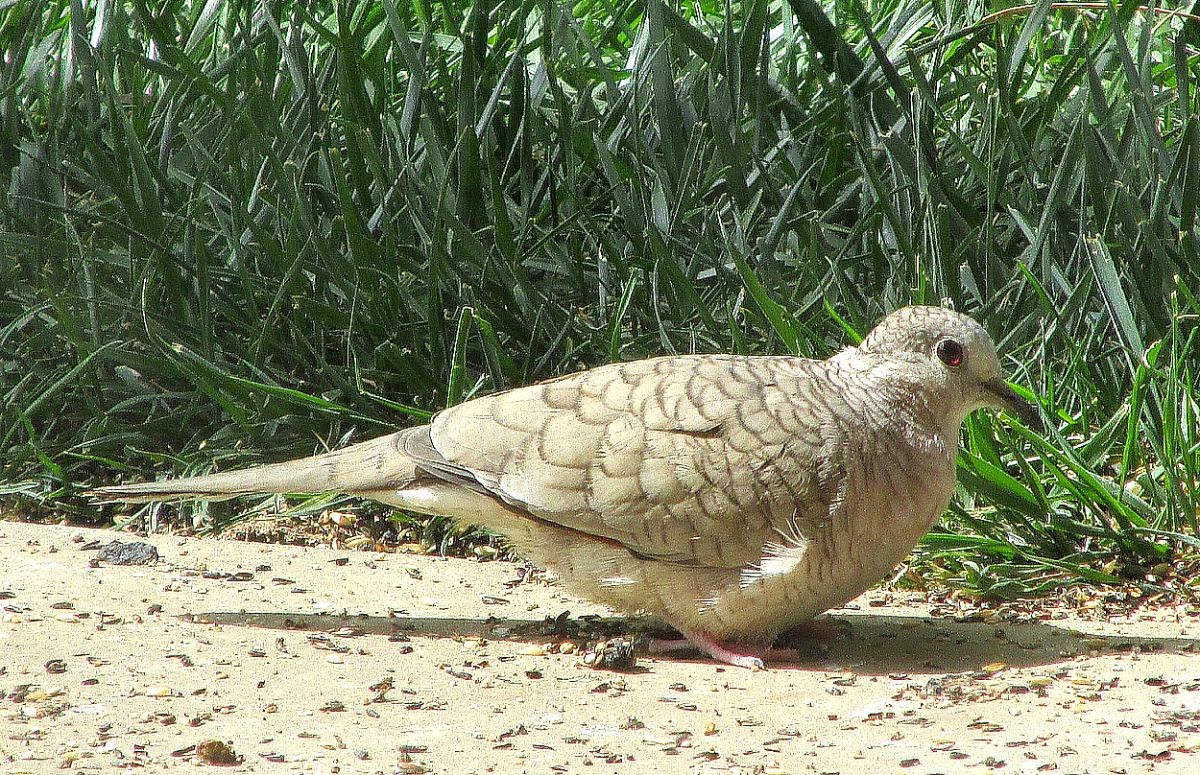
Inca Dove finally visits my yard instead of just calling in the distance.
I was sure the Mourning Dove would chase it away, but they fed peacefully together.
                The world is coming alive with the calls of birds. House finches, Mocking birds and Mourning doves all begin to practice their songs, getting ready for breeding season. Inca doves call in the distance.
                Yet one bird has reversed the process. I have heard a Costa’s hummingbird since the middle of February. One day in the middle of the month my house was surrounded all day by the whistling call of the Costa’s. The next day I didn’t hear a single whistle and haven’t ever since.
                I tend not to notice absence as quickly as I do presence. I did note that the north-side feeder didn’t need refilling as quickly as it had. At first I thought maybe there was something wrong with the feeder, so I gave it an extra cleaning and refilled it. Even then it just didn’t go down as fast. Then I noticed that the Anna’s feeding at the west-side feeder weren’t being chased away from the feeder, although they were still leery of settling, but that could be explained by the passing of finches on the way to the seed sock.
Anna's female hummingbird coming in to feed. Photo filtered to show details.
                It finally dawned on me. The Costa’s hummingbird was gone. Certainly it hadn’t gone north yet, spring isn’t far enough advanced for that.  Then I remembered, it was June 12 last year when the Costa’s made its first showing at my feeder. So where was it all spring?
                According to the bird guides, the Costa’s hummingbird prefers to spend spring in the desert. It only comes to town when the weather turns hot and the desert is no longer blooming. That is why I didn’t see him at my feeder until the middle of June.
                Okay, then why did they leave after spending all winter at my feeders? What could the desert offer that they couldn’t get in town?
                I finally thought to look at the app on my iPad, The Ultimate Southwest Desert Field Guide by the Audubon Society.  There was the answer under flowers that bloom in February. The red siren that lured the Costa’s away from my red feeders was Justicia californica. It goes by the common names of Mexican honeysuckle or Chuparosa, which is the colloquial name for hummingbird in Spanish. Another common name, this one says it all, is the hummingbird bush.
                This bush blooms from February through June. Its range matches the wintering range of the Costa’s hummingbird, except for that little piece called Las Vegas NV, where hummingbird feeders and introduced plants abound in the winter, but even that is not enough to keep the Costa’s from the desert in spring.
                As the other birds are slowly making their way northward, the Costa’s abruptly left for the southern deserts. The longer days and bright red blossoms lured it away, until June. Then it will be back at my feeder here in Las Vegas NV.