Friday, March 27, 2015

Failed Hummingbird Nest in Las Vegas NV – a sad story


                A female Costa’s hummingbird was queen of the north side feeder all winter. I took pictures of her in fair weather and foul. I was sure to see her sitting at the feeder or on the top of a dead branch next to the feeder.
                I identified her as a Costa’s based on two observations. One, there are only two wintering species here in Las Vegas NV, so she could only be a Costa’s or an Anna’s. Two, the Anna’s female has a tear drop of color on her throat; the Costa’s female does not. The north side queen did not have the tear drop and she was smaller than the Anna’s.
                Come warmer weather I didn’t see her anymore. I hoped that meant she had gone to the desert or headed up towards Utah, where some Costa’s summer.
                Then last Saturday my neighbor told me he had a hummingbird’s nest in his bottle brush bush that is between our two houses, on the north side of my place. I was excited since I have not had the privilege of watching a nesting hummingbird. Then he added: there were two eggs, but they were cracked.
Nest with broken eggs
                Right then I knew this was a failed nest. A female doesn’t ordinarily lay eggs and then desert the nest.  Either she is driven from her nest for some reason, or she dies. Suddenly the fact I hadn’t seen my Costa’s female lately became very disturbing. In all probability she is dead.
                I went out to see the nest and then asked permission to photograph it. From its location and construction I feel confident that it was her nest.
                Costa’s like to build their nests in open, sparsely leaved shrubs. They normally put the nest anywhere from two feet to eight feet above the ground. This one is at about five feet.
Nest securely tucked where limbs have been pruned off.
                The nest is constructed of plant fibers, spider webs, bits of leaves or flowers, and down. It is grayish in color.
                The nest fits all those descriptors.
Carefully constructed hummingbird nest
                So what happened to the mother? I don’t know. There simply hasn’t been any bad weather for her to contend with and she made it through the earlier bad weather just fine. Predators are always a possibility. This doesn’t have to be neighborhood cats. I have watched a Great Tailed Grackle peck an adult hummingbird to death, much to my horror. Disease is another possibility. This winter I watched my Mockingbirds get sick and disappear and a friend reported finding a dead hummingbird a few blocks from my house. From the description, it was an adult male.
                I was sad the whole rest of the day. My first hummingbird nest turned out not to be a source of joy, but one of sorrow. I have to keep reminding myself that failure and death is part of life, and just as important to the ultimate survival of the species, including humans, as success and birth, even here in the make-believe world of Las Vegas NV.

Saturday, February 21, 2015

Two hummingbird species winter in Las Vegas NV – how to tell them apart


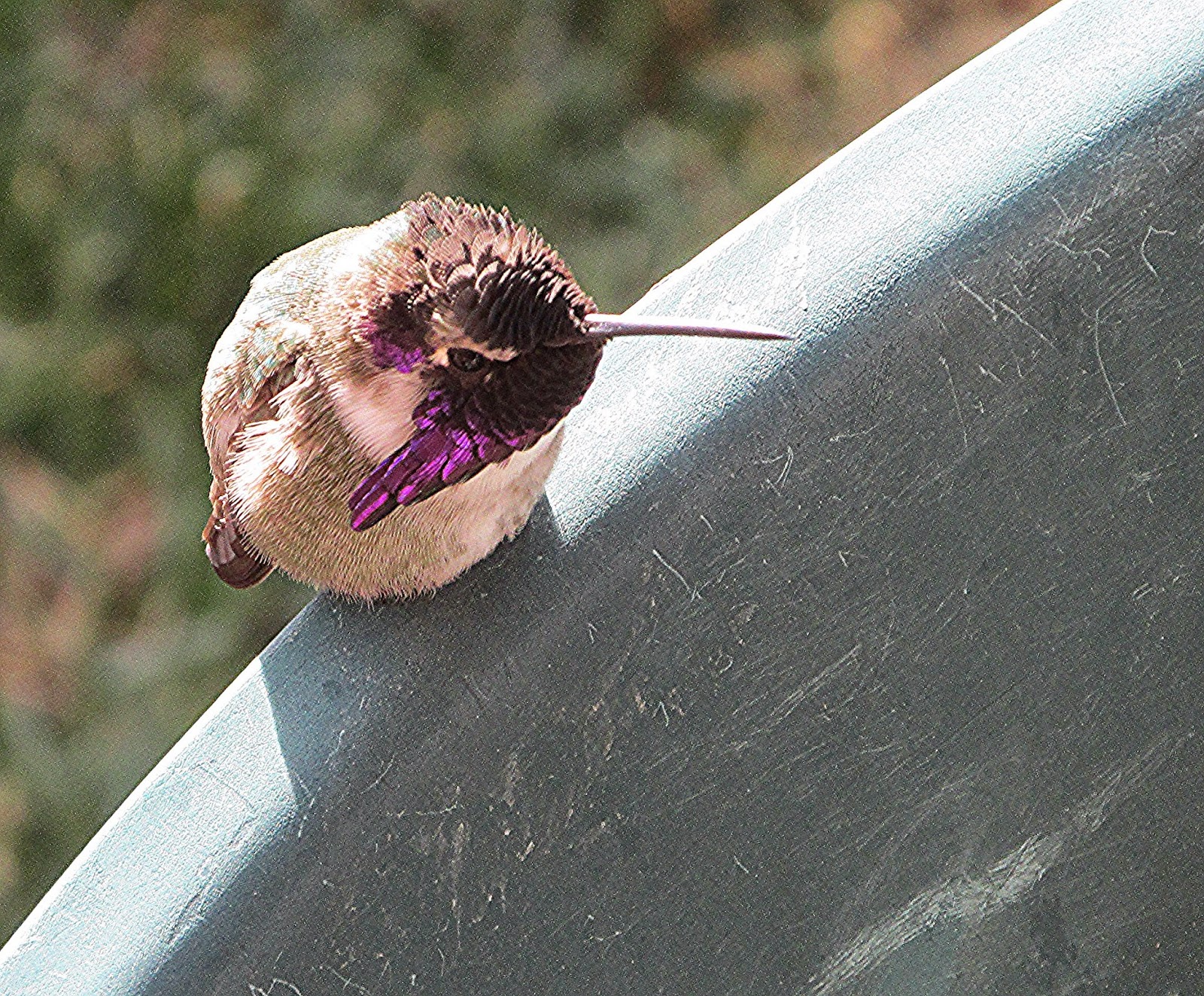
C Hummer taken from 2 feet away

                Here in Las Vegas NV we have two species that stay with us all winter – the Costa’s Hummingbird and the Anna’s Hummingbird. Even though we usually have at least one week, or more, of below freezing temperatures, they survive the winter with the help of feeders.
Anna's male, taken by a reader, used with permission
                When you look at pictures of hummers in the field guides they look so dissimilar, but seeing them in real life is a whole different story. The field guides use their best photos with the best light. The color of the gorget shows up well. When you see your hummer it may have entirely the wrong light on it. The gorget just looks dark; details are hard to see at best.  And then, of course, the hummer seldom stays long in one spot, so your look is fleeting.
                The more details you are aware of the better your chances of identifying the adult male hummer. The chances of getting a good identification of immature birds are slim, and females can be just as frustrating.
                After hours of looking and several really good photos, I feel a little more confident about differentiating between the Anna’s adult male and the Costa’s adult male that I see in my neighborhood.
                Let’s look at the similarities that exist between the Anna’s and Costa’s. These males are the only ones in our area that have colored heads. The color on the gorget is repeated on the top of the head. Our other summering hummers have green heads. This fact helps to eliminate choices in the summer, but doesn’t do us any good in the winter.
                The most obvious thing to look for is the shape of the gorget. The Costa’s gorget has very long side feathers that extend way down onto his shoulders. Behind his gorget at the sides and bottom there are long ‘hairy,’ perfectly white, feathers.
                Anna’s also has a gorget that extends to the side, but it is not so long, nor are the feathers themselves so long. The feathers next to the gorget are small and gray.
                Both birds have a white patch at the corner of the eye. The Costa’s patch joins with the white feathers along the side, while the Anna’s patch is cut off by more gorget feathers.
                The color of the gorget differs. While both will simply look dark in bad light, and have a rosy look in other lights, good light tells another story. Anna’s gorget is red-pink, yet if you see it in bright light it will look golden. Costa’s, on the other hand, looks purple and sometimes even shades towards the blue.
                A look at their breasts shows yet other differences. The Costa’s is speckled with a definite white stripe down the front and a green hue on the sides. Anna’s has a scalloped pattern on the feathers, no white stripe and tends towards the grey with just a hint of green.   
                Their tails also are different. Costa’s tail is shorter than the wing tips; Ann’s tail is longer than the wing tips.
                Even with all these things to look at, there will be days when identification is iffy at best. So I wish you good luck and good light in your efforts at hummingbird identification.


Sunday, January 11, 2015

C Hummer keeps watch in his yard in Las Vegas – and keeps me amused.


                I don’t see C Hummer on his chair back under the hummingbird feeder very often any more. With the advent of warmer weather he has moved into the bushes around my home where he can watch for insects. That doesn’t mean he isn’t aware of my every move though. Yesterday, when the weather was warm and dry, I walked toward my driveway. I hadn’t gotten much past the kitchen when C Hummer was hovering right in front of my face.
Flapping his wings to shake off the raindrops
                The light was perfect for showing his colors. I just stood in awe of his iridescent glory, but I finally I had to explain to him that I needed to move and he was blocking my path. With that he flew off into the Texas Sage.
                Later that day I had to fill the south-side feeder. This one, the favorite of finches and Verdins – as well as hummingbirds, has to be filled on a daily basis. Since it had some sweet water in it before dawn, when I normally check my feeders, I left it until later. By afternoon it was down to the last few drops. I took it off the hook and brought it to the kitchen to wash and fill. As I stood at the kitchen sink I looked up and saw C Hummer. He was hovering right in front of the window over the sink looking into the house. I feel certain he was watching me to see that I was filling the feeder properly!
Mrs. C Hummer, shaking off the rain
                When the rain came on Sunday January 11, 2015 and stayed all day, the birds got thoroughly soaked. I was out when the first raindrops came down. C Hummer was on the Lady Bank’s Rose that grow over a neighbor’s wall in front of my house. Every time a drop hit him, he flapped his wings to shake it off. Later, when the rain really started coming down, he was kept very busy shaking it off, as he stayed in the Bank’s Rose bush.
                Meanwhile on the north side, Mrs. C Hummer, a female Costa’s Hummingbird who has taken over the north-side feeder, kept her post on the bare branch next to that feeder. She had to constantly shake to throw off the raindrops too.
Note the rain on the chair
                As the day wore on and the rain continued, C Hummer decided it was time to move back to the patio where he could be under the roof. If he wasn’t on the back of the chair, he was on the wind chime.
Note the water on the wall
However, he wasn’t the only one who decided that was a good move. The finches found perches on the feeders and stayed awhile to dry off a bit before they went back to the seed sock.
finches keeping dry
                Even one very wet and bedraggled Mockingbird, who isn’t the least bit interested in the feed, came to rest on the back of another chair, seeking a respite from the wet of the day.
                At the time I write this, we have had between a third and a half inch of rain. For us here in Las Vegas, that is the most rain we have seen in months. The birds and I both hope that tomorrow will return to dry, sunny and warm. Not that I don’t like rain, but I moved to the desert for a reason, and that doesn’t include cold, dreary, gray, wet days. And I’m sure the Costa’s and Anna’s hummingbirds that chose to winter here didn’t stay for that kind of weather either.
Such a beautiful bird!


Thursday, December 25, 2014

Costa’s hummingbird owns my yard in Las Vegas – C Hummer gets tamer


                Let’s be honest. I thought this was my place, but no. I my own the house, but C Hummer owns the yard. When I sit outside on a pleasant afternoon he buzzes by me, sits in the bush next to me and scolds. When I take the feeder in to refill, he lets me know that is his feeder by zipping around me and scolding. The last time I sat outside, when we had a record breaking high of 75 on December 22, C Hummer sat right over my head on the bill of the hummingbird wind chime and whistled, letting me know that was his territory.
               
Looking down on C Hummer, I'm only a few feet away!
Yes, without doubt he owns the place. With ownership comes confidence and confidence he has a plenty. Just as it is getting light in the morning, I return from walking the dogs. We come around the corner of the house where a Texas sage grows in the corner between the garage and the kitchen. I often hear his chirp coming from the bush or see him hovering in the heart of it. On one morning this week, I stopped to watch for him when I heard the hum of his wings. I saw him hovering. Then he spotted me and dogs. He came within a foot of my face and sat on a small branch watching me. He sat there looked at me, looked at the dogs and back at me. I finally told him I needed to go into the house and left. I don’t know how long he would have stayed if I had waited.
                That same day I needed to fill the favorite sweet-water feeder. It needs filling everyday because it not only attracts hummers, but numerous house finches and Verdins.  C Hummer was sitting on the back of the chair on the patio. I had to go right past him to get to the feeder. I walked slowly wondering at what point he would fly off. I was within a foot of the chair when off he went.
Taken without zoom from about five feet away.
                On the way back with the filled feeder I again had to walk right past him. This time I stopped before he flew off and held the feeder in front of him. He quickly came to it, sat on a perch, drank, moved to another perch, and drank some more.  All this while, I was holding the feeder in my hand. When he flew off I was able to hang it where it belonged.
                The most amazing, and worrying, thing though is his attitude towards my dogs. Maybe he sees them as an extension of me. Because the dogs don’t move slowly, C Hummer flies off when then go out on the patio. This one day, I let one dog out, he ran across the patio and out into the yard. The hummer didn’t move. Okay, the dog didn’t go towards him so I supposed that’s why he stayed perched on the back of the chair. Then the dog came back to the patio. This time my dog spotted the hummer and headed towards him. I watched, ready to yell ‘NO! ‘if he got too close. The dog walked over to the chair and put his nose up to sniff the bird. I was relieved when C Hummer flew off. Then alarmed, when instead of leaving the area, he came back. He hovered in front of my dog and touched noses with him. Of course I didn’t have my camera with me. And I hope, for the sake of my nerves, that I don’t see that again!
Taken without zoom from about a foot from the chair.
                I normally don’t name wild animals since it is emotionally safer not to. C Hummer is different because he has found his way into a series of children’s picture books I am writing, not about birds, but about cats. C Hummer is such a character he just has to become one of the main characters. So C Hummer he has become. I wonder what he’ll do next in my – pardon me, his – yard in Las Vegas NV.